IEC 60601, 4th Edition: What’s Changing and How to Prepare

IEC 60601, 4th Edition: What’s Changing and How to Prepare

IEC 60601-1, 4th Edition
Strategic Shifts and How to Prepare

Companion post to my Easy Medical Device podcast episode on IEC 60601-1, 4th Ed., focused on what is shifting across the Working Groups and what RA/QA, Design, Test, and Management teams should do now.

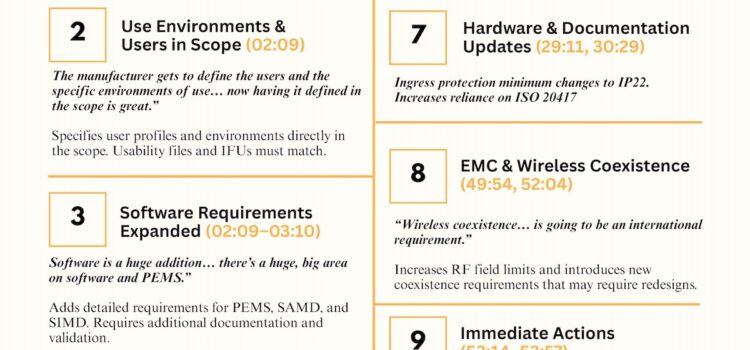
Most organizations will feel the impact long before any formal transition date. The practical shift is that evidence expectations are tightening, scope is becoming clearer, and the standard’s direction is being shaped now through Working Group outputs. Teams that treat this as a design input and planning topic today will avoid late-cycle surprises in test strategy, labeling, and documentation tomorrow.


Medical Device Compliance & Certification Summit – Why It Matters?

Medical Device Compliance & Certification Summit – Why It Matters?

Medical device and diagnostic compliance expectations are shifting earlier in the product lifecycle. IEC 60601 and related standards are no longer something teams can “handle at test.” Regulators increasingly expect standards interpretation, risk decisions, and test strategy to be visible and justified during design reviews and technical documentation development.

This shift is showing up in real ways – through tougher design reviews, deeper questions during pre-submission interactions, and increased scrutiny of how standards were applied, not just whether a final test report exists.

To address this reality, Eisner Safety Consultants (ESC) is working with Nemko to deliver a three-day, in-person Medical Device Compliance & Certification Summit focused on how standards, testing, and regulatory expectations intersect in real programs.

This is a focused, three-day program for engineering, regulatory, and compliance teams navigating IEC 60601, IEC 61010, EMC and RF requirements, certification strategy, and regulator guidance documents across FDA, EU, and other markets.

What’s NASA & Star Trek have to do with IEC 60601?

What’s NASA & Star Trek have to do with IEC 60601?

From NASA to IEC 60601 – A Lifelong Trek for Safer Devices.

When I was in high school, I had no idea a simple work study opportunity would redirect my entire future. That is exactly what happened when I was beamed over to NASA for the first time. That early exposure to real world engineering lit a spark that has stayed with me ever since. A curiosity for science, safety, and how technology can genuinely serve people.

All these decades later, that same curiosity still energizes my work with IEC 60601, patient safety, and supporting the MedTech industry. So when I joined Faisal Kamal on The ⭕️ Podcast, it felt like a perfect chance to bring all these threads together. Star Trek. NASA. Standards. Innovation. Human factors. EMS & Home use environments.. And above all, patient safety.

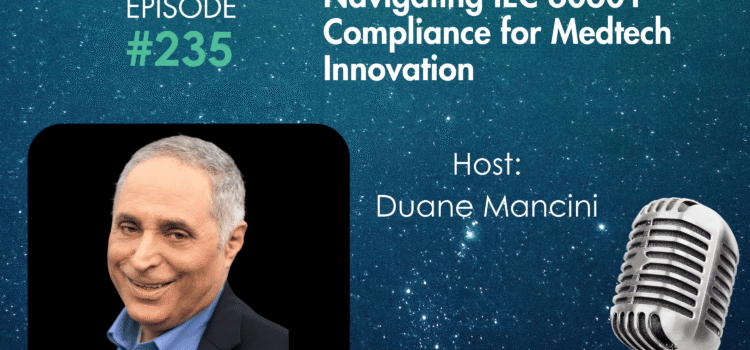
From Engineer To “The IEC 60601 Guy” – Project MedTech Podcast

From Engineer To “The IEC 60601 Guy” – Project MedTech Podcast

From engineer to “The IEC 60601 Guy” — my story and practical tips
I joined Duane Mancini on the Project Medtech Podcast to share how I became known for IEC 60601, why the series is a roadmap you can follow, and what 4th Edition changes mean for design, QMS, and documentation.

A quick personal note
Nobody starts at the top as “The IEC 60601 Guy.” My path ran through early days at NASA, many years in test labs, and deep work in standards committees. What stuck with me is simple — stay curious, do the work, and show the work. That’s how we turn a dense standard into a practical plan.

IEC 60601-1, 4th Edition Survival Guide – Why It Matters For MedTech

IEC 60601-1, 4th Edition Survival Guide – Why It Matters For MedTech

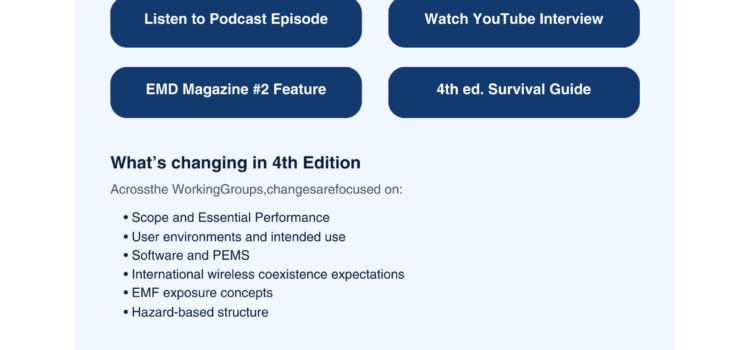
The 4th Edition of IEC 60601-1 is no longer a future concern. Eleven of the twelve hazard fragments (WGs 37–48) have circulated Committee Drafts (CDs). All fragments have issued first CDs (WG 47 is at CD2), except WG 45 (Optical Radiation Hazards).

That means manufacturers, design houses, trade associations, test houses, and regulators must follow the working group outputs closely. If you cannot stay directly engaged in National or International (IEC) committees, you will need trusted expert guidance. These changes will impact design, QMS, labeling and IFUs, documentation, and test strategies.