
Almost nobody reads a thousand-page draft cover to cover. So here is one place to get oriented, then go deep only where it touches your device.

You have heard the headline: the IEC 60601-1 4th edition is coming, and it is big. Edition 3.2 is around 500 pages. The 4th edition is heading past 1,000, written across twelve hazard-based working groups.
The headline is not the useful part. The useful part is the question underneath it: where do you start, and what do you actually need to read? Almost nobody reads a thousand-page draft cover to cover, and nobody should have to. So this is a hub. It is one place to get oriented and then go deep only where it touches your device, as your device likely will not touch every corner of the standard.
Want this mapped to your specific device or learn more about IEC 60601-1, 4th Ed.? That is the work my team does with clients.
Schedule a call Get the newsletter1. The structure: twelve hazard-based fragments
Edition 3.2 is organized by clause. You find a requirement by its number. The 4th edition is currently organized by hazard, split across fragment working groups that will later be merged into one document. Each hazard concept is a fragment, and each fragment has its own working group. Here is the whole map, and where each fragment stands today:
| Fragment | Working Group | Hazard area | Latest draft |
|---|---|---|---|
| Frag 1 | WG 37 | General requirements | CD2 |
| Frag 2 | WG 38 | Physical environment hazards | CD2 |
| Frag 3 | WG 39 | User interface hazards: (usability, information supplied by the manufacturer, alarms) | CD2 |
| Frag 4 | WG 40 | Materials hazards: (biocompatibility; cleaning, disinfection, & sterilization) | CD3 |
| Frag 5 | WG 41 | PEMS / software: (SaMD, SiMD, firmware, apps, OS, drivers) | CD1 |
| Frag 6 | WG 42 | Electrical hazards | CD1 |
| Frag 7 | WG 43 | Mechanical hazards: (including acoustic, pneumatic, vibration energy) | CD1 |
| Frag 8 | WG 44 | Thermal and fire hazards | CD1 |
| Frag 9 | WG 45 | Optical radiation hazards: (visible, UV, IR) | CD1 |
| Frag 10 | WG 46 | Ionizing radiation hazards | CD2 |
| Frag 11 | WG 47 | Electromagnetic exposure (EMF) hazards, including SAR | CD2 |
| Frag 12 | WG 48 | Electromagnetic disturbances: emissions, immunity, wireless coexistence | CD1 |
Draft status, committee-draft stage, as of 20 October 2026. “CD” = committee draft; higher numbers are later rounds. Treat all fragment content as current draft, not final.
That structure is not arbitrary, and you do not have to take my word for it. Behind it sits the Architectural Specification (approved 5 May 2020), which sets the direction for the edition, sharpening the focus of basic safety and essential performance and pushing toward discrete, design-ready requirements. The Design Specification Outline (30 November 2023) then implements that architecture, laying out how the work is grouped into the twelve hazard concepts above. An editing team, AG 50, the leadership of all twelve working groups, keeps twelve fragments reading as one standard.
Both specifications are public documents you can read yourself:
Architectural Specification (2020): assets.iec.ch/public/tc62/62_348e_Q
Design Specification Outline (2023): assets.iec.ch/public/sc62a/IEC_60601-1_Ed._4.0_Design_Specification
Most people never look at this layer. The original concepts have evolved since these specs were written, based on the experts and National Committee feedback, but they remain the best window into why the 4th edition is shaped the way it is.
2. Where the drafts stand, and the timeline
You do not have to track every document to stay oriented. Every one of the twelve fragments now has at least a first committee draft. Several are on their second draft, and Fragment 4 is furthest along at CD3. It will probably be the only CD3: for most fragments the intent is to publish a CD2, get comments from the National Committees, and move on. A third CD made sense only for WG 40, which has the time and bandwidth in its group to complete one before the project needs to move into the CDV1 phase.
Three fragment drafts dropped on 3 July 2026: Physical environment (Frag 2), Materials (Frag 4) and Ionizing radiation (Frag 10). The compilations of comments (CCs) for all three were issued on 2 October 2026 (62A/1774/CC, 62A/1775/CC and 62A/1773/CC). The working groups resolve those comments at the Hamburg meeting in mid November 2026, and the outcome becomes the next draft of each fragment. Watch for those next drafts, to review and comment on, sometime after Hamburg.
The map moved again on 24 July 2026: Fragment 1 (General requirements) issued its 2nd committee draft (62A/1759/CD), with comments closed 16 October 2026. Fragment 12 (electromagnetic disturbances) is the one still to come. WG 48 did not publish the Fragment 12 CD2 over the weekend of 1–2 August 2026, so it is not expected until after the Hamburg meeting. It still had not circulated as of 20 October 2026.
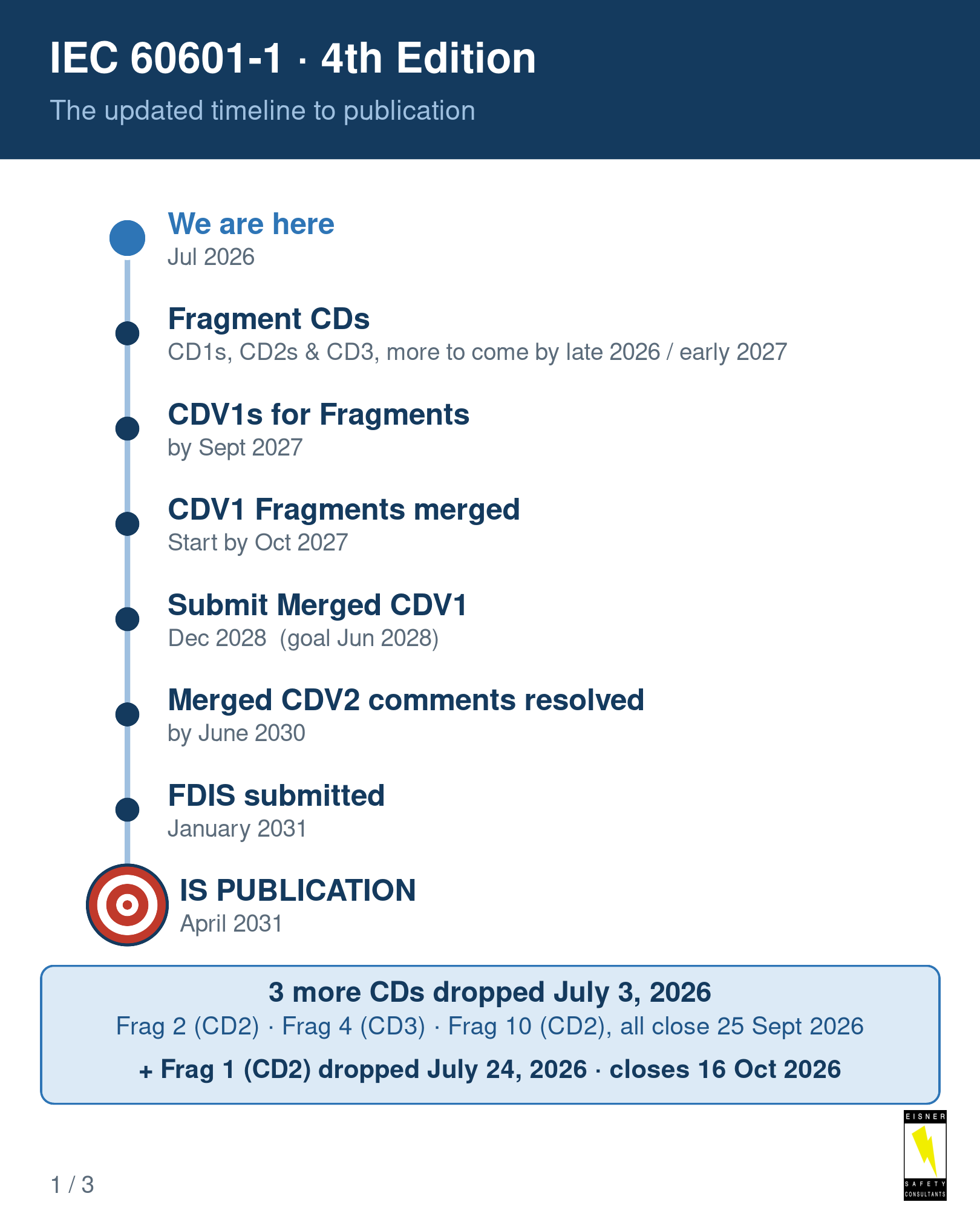
| Milestone | Target |
|---|---|
| Official kickoff | April 2024 |
| Fragment committee drafts (CD1 / CD2 / CD3) | Through 2026 into early 2027 |
| Fragments begin merging into one document (toward CDV1) | ~ October 2027 |
| Submit Merged CDV1 | December 2028 (goal June 2028) |
| Merged CDV2 comments resolved | ~ June 2030 |
| FDIS Submitted | ~ January 2031 |
| IS Publication | ~ April 2031 |
Treat the dates as goals; these schedules are likely to shift again. The point is the opposite of “relax, it is years away.” The text that becomes the 2031 standard is being written and commented on right now, and if you or your organization are not directly involved in writing the document (not one of the experts on the WG committees), the comment windows are the best way to provide your feedback.
3. Where to go deeper (the shelf)
You do not need to read everything, but you do need to start preparing now and understand the impact on your device designs, your test plans, your QMS, your document control, and your supply chain. Here is a starter kit to map to your device, plus a couple of orientation pieces:
- The TÜV Rheinland 4th-edition seminar, presented by Leo Eisner, Caitlin Brady and Elizabeth Casey. Working-group material from the people writing the drafts.
- The EU MDR / EN 60601-1 harmonisation cheat sheet on how the current standard lines up with the MDR, Annex ZZ, and state of the art.
- The 4th-edition one-page cheat sheet: IEC 60601-1, 4th Edition: Strategic Changes and Preparation Strategy.
- The LinkedIn series this hub grew from: the opening post lays out the three running series. The full, updated index of every post is below.
4. The series index: every post, by track
Three series run in parallel. This index is kept current as posts publish, so it is the one place to find them all. Each post is listed once, under the series it was written for; where it also touches another track, the description says so.
Start here
- The opener: 500 pages to 1,000+, and the three running series — what the whole thing is and how it is organised.
Series 1: the CEP and CEF, start now
The conformity evaluation plan and the conformity evaluation file: what the 4th edition expects of them, and how to start putting them to work under Edition 3.2 now.
- The CEP and the CEF: start now, under Edition 3.2 — what the plan and the file actually hold, the traceability chain, and why nothing in Edition 3.2 stops you working this way today.
Series 2: the 4th edition, fragment by fragment
How the edition is structured, and what is changing in each hazard working group.
- Where the structure came from: the Architecture and Design Specifications, and AG 50 — also touches the CEP.
- The twelve fragments, and where each draft stands today
- Your EMC/EMD test plan is yours to write, not the test house’s — the plans you already owe today, and how Fragment 12 raises the bar in the 4th edition.
- How much of the 4th edition actually applies to your device — almost every hazard fragment reaches almost every device, to differing degrees; only optical and ionizing radiation are genuinely device-specific.
- How to Read the IEC 60601-1 4th Edition: 12 Fragments, Not Clauses : the long form on the blog. Why the edition is built by hazard, what CD1, CD2 and CD3 actually mean, a seven-step reading order, and where Fragment 1 leads: the conformity evaluation plan and file.
Series 3: Standards Watch
New and draft standards as they land, inside the 60601 family and beyond it, with the comment windows that decide the final text.
- The updated 4th-edition timeline and the July committee drafts — the schedule out to about 2031, and the three fragment drafts that opened for comment.
- Combination products: ISO TS 24971-3, and where the risk lives — a device plus a drug or biological product, and the risks that only appear once they are combined.
- EMF exposure assessment: IEC TS 63738 enters comment — the technical specification feeding the Fragment 11 electromagnetic exposure work.
- IEC 60601-1 and IEC 62304 as Group Safety Publications — SC 62A’s application for horizontal status, and why it names two editions that do not exist yet. National Committee responses closed 11 September 2026. The revised application goes to the SC 62A plenary in Hamburg on 17 November 2026 (62A/1770/RQ).
- Standards Watch: six weeks of committee movement in one post (20 October 2026) — the 4th edition fragments, the particular standards, the new graphical symbols and safety signs deadline, and the Hamburg November 2026 schedule, all at a glance in the post’s graphic.

5. Strategic readiness: your action items
You do not need the final text to start. Here is the readiness list I walk teams through:
- Map your design controls against the draft working-group requirements now, rather than waiting for the next draft.
- Run a full QMS gap analysis: risk management file, conformity evaluation file, and the EMF and biocompatibility assessment reports.
- Pull R&D, RA/QA, software, labeling, supplier quality and manufacturing into your readiness reviews. This is not a regulatory-only exercise.
- Embed cybersecurity, AI/ML and PEMS design inputs early in the pipeline, not at verification.
- Update labeling, symbols, packaging and IFU against ISO 20417 and the working-group requirements.
- Engage suppliers now for SBOM, spacing changes, power cords and component impacts. Supplier lead time is where these programs slip.
That list is the orientation. Turning it into a real gap analysis and a plan for your specific device is the part that takes experienced hands. Day to day, my team supports manufacturers, test labs, and regulators with exactly this: strategic readiness, CEP/CEF development, and training teams up on the 4th edition. It does not have to be a heavy engagement, either. One client took a four-hour CEP/CEF workshop and had the concept working in their process the next week.
Turn this into practical action
If you have been meaning to get oriented on the 4th edition and did not know where to start: start here, with Eisner Safety Consultants support.
Schedule a call with Leo, the IEC 60601 Guy Join the ESC newsletter Connect with Leo on LinkedInThe newsletter carries the deeper analysis and the extras that never make the short LinkedIn posts. Keep the conversation going on LinkedIn.