
How to Read the IEC 60601-1 4th Edition: 12 Fragments, Not Clauses

How to Read the IEC 60601-1 4th Edition: 12 Fragments, Not Clauses

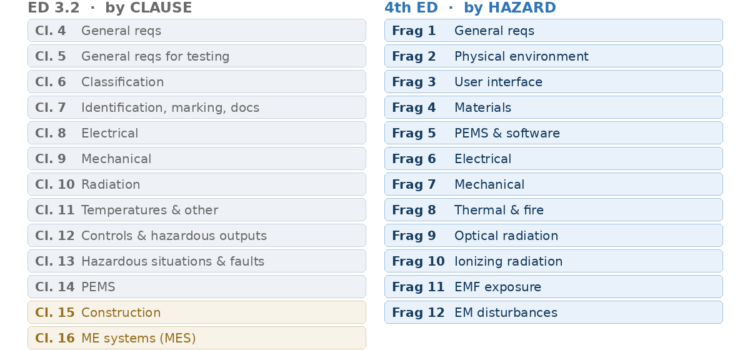
The IEC 60601-1 4th edition is organized by hazard, not by clause. That is not a cosmetic change, and it decides how you read every draft that follows.

Edition 3.2 of IEC 60601-1 is organized by clause. You want leakage current, you go to Clause 8. You want mechanical hazards, you go to Clause 9. You want excessive temperatures, you go to Clause 11.

The 4th edition is not built that way, and the difference is not cosmetic. It changes what you look up, how you scope your project, and what a gap analysis against it actually has to do.

Here is what sits underneath the change, why it was made, and how to read the drafts without getting lost in them.


The IEC 60601-1 4th edition, in one place: the map, the timeline, and where to actually start

The IEC 60601-1 4th edition, in one place: the map, the timeline, and where to actually start

Almost nobody reads a thousand-page draft cover to cover. So here is one place to get oriented, then go deep only where it touches your device.

You have heard the headline: the IEC 60601-1 4th edition is coming, and it is big. Edition 3.2 is around 500 pages. The 4th edition is heading past 1,000, written across twelve hazard-based working groups.

The headline is not the useful part. The useful part is the question underneath it: where do you start, and what do you actually need to read? Almost nobody reads a thousand-page draft cover to cover, and nobody should have to. So this is a hub. It is one place to get oriented and then go deep only where it touches your device, as your device likely will not touch every corner of the standard.

Major changes to IEC 60601-1 are closer than you think

Impact of IEC 60601-1, 4th Ed.

Once the 4th Edition is published, redesigns and QMS updates will be far more costly.

Direct insights from someone in the development of IEC 60601-1, 4th Edition
Get an insider’s view of the upcoming changes, their real-world impact, and how to prepare, from someone directly involved in developing the standard.

🎩 Get your reviewer’s hat on – IEC 60601-1, 4th Edition Draft Fragments Have Dropped‼️ 🚀

🎩 Get your reviewer’s hat on – IEC 60601-1, 4th Edition Draft Fragments Have Dropped‼️ 🚀

Over the last two weeks – and with a Friday night (6/20/25 Geneva time – late) finale still to come – we’ve seen CD1s and CD2 (WG 47 ONLY) fly out for Fragments 5, 6, 7, 8, 10, 11, and 12 from WG 41 through WG 48, but for WG 45.

This is not just standards spring cleaning – these are foundational changes to the IEC 60601-1 General Standard, folding the Collateral standards into the core. If you have medical electrical equipment, medical electrical systems or software SaMD or SiMD you need to be aware of these changes. If you’re a manufacturer, test lab, trade association, Notified Body, Regulator or other interested party who owns a risk file… you need to review this.

Join me for an Interactive Workshop Identifying Standards, Guidances, & Turn Standards into Your Competitive Advantage @ 10X

Join me for an Interactive Workshop Identifying Standards, Guidances, & Turn Standards into Your Competitive Advantage @ 10X

Don’t make the 5 costly mistakes companies make with Medical Device Standards. Learn from the IEC 60601 Guy himself.:

Late Identification of Applicable Standards: Leads to expensive redesigns and delayed timelines

Ignoring Expert Standards Guidance: Results in regulatory rejections and costly resubmissions

Unprepared Risk Management File for Testing: Risks unnecessary costs due to lack of strategic planning for compliance.

Unprepared Regulatory Submissions: Leads to costly setbacks and market-entry delays

Underestimating Education and Training: Creates knowledge gaps, increasing errors and compliance risks.